Your resume? Yeah, it’s probably getting ignored. No offense.
In 2026, blindly hitting “apply” with a generic resume is basically sending it to the digital trash can. I know because I’ve been on the other side, sifting through hundreds of applications for growth roles at AICreatify. To stand out, you must match your resume to a job description. What makes one resume jump out? Simple: it screams “I understand your pain points and I can solve them.”
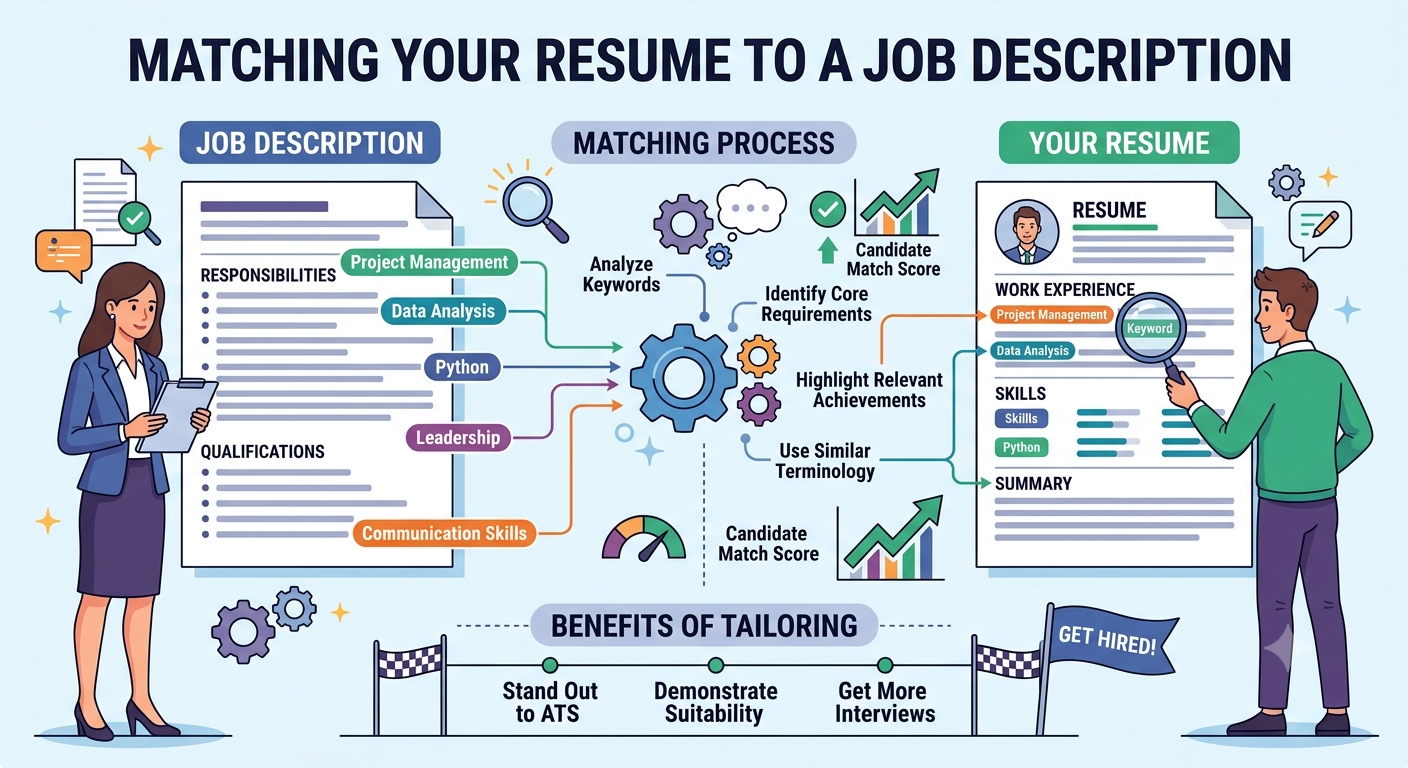
Effectively matching your resume to a job description means analyzing the description for keywords and core requirements, finding your most relevant skills and achievements, and then tailoring your resume’s language, experience, and quantifiable results to directly connect with what the employer needs. This often means using AI tools for speed, but always with your human review and personalization.
Key Takeaways
- Deconstruct the JD like a Detective: Figure out the employer’s “must-haves” and core problems before you even touch your resume.
- AI is Your Assistant, Not Your Ghostwriter: Use tools to spot gaps and refine language, but always add your human touch.
- Lead with Impact, Not Just Duties: Your resume isn’t a job history report, it’s a sales pitch for your future value.
- Avoid the ATS Traps: Keyword stuffing and generic language are instant disqualifiers in a competitive market.
Table of Contents
- Why You Must Match Your Resume to a Job Description
- The “Reverse Engineering the JD” Framework: Your Blueprint
- A Step-by-Step Guide to Tailoring Your Resume
- Using AI to Match Your Resume (Smartly): A 2026 Workflow
- Example: Matching a Marketing Resume to a Digital Marketing Manager Role
- The “Impact-First, Role-Second” Philosophy: A Game Changer
- Common Mistakes to Avoid When Matching Your Resume
- Frequently Asked Questions About Resume Matching
- AICreatify’s Resume Optimization Tool: Your Final Check
- Get Noticed, Get Interviewed
Why You Must Match Your Resume to a Job Description
Look, I’ve run enough growth campaigns to know that generic messages get zero traction. Your resume is no different. It’s the ultimate marketing document for yourself.
First, the gatekeepers: Applicant Tracking Systems (ATS). You might think they’re some mythical beast, but they’re very real, and they’re your first hurdle. Approximately 98% of Fortune 500 companies and over 75% of all businesses use ATS to screen resumes (Jobscan, 2023). If your resume doesn’t speak their language (aka, the job description’s language), the ATS kicks it out before a human even sees it. Tough, but true.
Then there’s the human factor. Once you beat the ATS, you’re trying to impress a busy hiring manager (often me, or someone like me). Recruiters spend an average of just 6-7 seconds reviewing a resume during the initial scan (The Ladders, 2022). Six seconds! That’s less time than it takes to scroll past a mediocre LinkedIn post. Your resume needs to hit them with relevance, impact, and a clear “why you” message immediately.
You can’t just list what you did. You need to show how what you did solves their specific problems. Madeline Mann, the genius behind Self-Made Millennial, constantly shows how transforming a generic “Managed social media” into “Spearheaded Instagram strategy, increasing follower count by 30% and boosting engagement by 25% within six months, directly contributing to a 10% uplift in e-commerce sales” makes all the difference. It’s about showing true fit, not just a keyword count. Even the giants like Google implicitly demand extreme tailoring; their successful candidates meticulously dissect JDs to align their experience with the company’s hyper-specific needs and values.
The “Reverse Engineering the JD” Framework: Your Blueprint
Forget reading the job description like a list of chores. You need to read it like you’re the hiring manager who wrote it. Seriously, put yourself in their shoes. What problem are they really trying to solve with this hire?
Step 1: Break Down the Job Description for Key Requirements
Print it out, or if you’re like me, open it in a Google Doc and go wild with the highlighter tool.
- Identify “Must-Haves” vs. “Nice-to-Haves”: Grab a red marker (or virtual highlight color) for anything non-negotiable: specific certifications, required years of experience, critical software. If you don’t hit these, you either need a stellar cover letter to bridge the gap or, honestly, it might not be the right role. Use yellow for the “nice-to-haves” – these are bonus points, but don’t let them overshadow your core qualifications.
- Uncover the Employer’s Core Problems: This is the secret sauce. Don’t just list what they want; ask why they want it. What challenge is this person expected to fix? Is it stagnant growth? Poor customer retention? Inefficient processes? Look for phrases like “responsible for X growth,” “addressing Y challenge,” “improving Z efficiency.” If the JD keeps mentioning “scaling user acquisition,” you know their core problem is likely a need for more users. Your resume needs to show you’re the solution.
Step 2: Spot Core Keywords and Action Verbs
Think like an ATS, but write for a human.
- Extract Direct Keywords: Make a list of 10-15 specific nouns, technical terms, software, or methodologies (like “Agile” or “Scrum”) that pop up repeatedly in the JD. These are your gold.
- Extract Powerful Action Verbs: Notice the verbs they use. “Spearheaded”? “Orchestrated”? “Delivered”? “Optimized”? “Increased”? “Reduced”? These are the verbs they value, so use them in your own bullet points.
- Beyond the Obvious: Contextual Keywords: Don’t limit yourself to exact matches. If they say “customer relationship management,” make sure “CRM” is also on your radar if it applies. If “data analysis” is a big deal, think about the tools: “SQL,” “Python (Pandas),” “Tableau.”
Step 3: Map Your Experience to Their Needs
This is where you connect your dots to their dots. For every “Must-Have” or “Core Problem” you identified, brainstorm 1-2 concrete achievements from your past that directly speak to it.
Here’s a simple worksheet I’d use to map this out:
| JD Requirement (Must-Have/Problem) | Keywords/Action Verbs | My Relevant Experience/Achievement (Draft) | Quantifiable Impact (Draft) |
|---|---|---|---|
| Scale user acquisition | User acquisition, funnel optimization, conversion rates | Led 3 campaigns, optimized funnels | Increased sign-ups by 25% |
| Manage B2B sales pipeline | CRM, sales cycle, lead generation | Managed 50+ accounts, prospected | Achieved 120% quota in Q3 |
| Develop secure APIs | API development, cybersecurity, RESTful | Built 5 APIs, ensured data security | Reduced vulnerabilities by 15% |
This worksheet helps you bridge the gap. You’re not just listing skills; you’re showing how you used them.
A Step-by-Step Guide to Tailoring Your Resume
Alright, now you’ve got your blueprint. Time to build.
Preparation & Analysis
- Download the JD and Your Current Resume: Keep them separate, for now. Use a digital editor like Google Docs or Word for the JD.
- Highlighting and Annotation: Apply the red and yellow highlights from the “Reverse Engineering” step. Add notes about how your experience aligns.
Resume Content Optimization
This is where the magic happens. Every single section of your resume gets the spotlight.
Crafting a Targeted Summary/Objective:
- Template: “Highly [Adjective 1] and [Adjective 2] professional with [X years] of experience in [Industry/Domain], specializing in [2-3 key skills directly from JD, e.g., ‘digital marketing strategy’ and ‘performance campaign optimization’]. Proven track record of [quantifiable achievement directly addressing a core JD problem, e.g., ‘driving 25% growth in user acquisition’] for [type of company/product]. Ready to apply expertise in [another key skill] to [achieve a specific goal for the employer, e.g., ‘scale market reach for ABC Corp.’]”
- Example: “Highly analytical and results-driven Marketing Leader with 8+ years of experience in SaaS, specializing in full-funnel digital marketing strategy and performance campaign optimization. Proven track record of driving 25% year-over-year growth in user acquisition and improving conversion rates by 15% for B2B tech platforms. Ready to apply expertise in data-driven decision-making and team leadership to scale market reach and exceed revenue targets for [Target Company Name].”
Integrating Keywords into Experience Bullet Points:
Go through each bullet point in your experience section. Replace generic words with the JD’s specific vocabulary. Make it flow naturally.
- Before: “Managed social media for a company.”
- After: “Developed and executed comprehensive social media strategies across Instagram, TikTok, and LinkedIn, aligning with brand voice and achieving 15% growth in brand engagement.”
Showcasing Relevant Skills (Hard & Soft):
Your skills section needs to be laser-focused. Prioritize technical skills first. If the JD mentions “SQL,” “Python,” or “Google Analytics,” make sure they’re there.
- Don’t just list soft skills. Weave them into your experience bullets: “Led cross-functional teams of 8 engineers and designers…” or “Facilitated stakeholder communication to achieve project alignment…”
Quantifying Your Achievements for Impact:
This isn’t optional. Numbers prove your value. Percentages, dollar amounts, number of projects, time saved – if you can add a number, add it.
- Before: “Improved website traffic.”
- After: “Increased organic website traffic by 30% through targeted SEO strategies, resulting in a 15% uplift in lead generation within 6 months.”
Review & Refinement
- Proofreading for Perfection: Read your resume aloud. Seriously, it helps catch awkward phrasing. Use a grammar checker. Then, have a trusted friend look it over. Typos? They’re an instant disqualifier in 2026.
- Testing ATS Compatibility: Before you hit submit, run your resume through an ATS-scanning tool. You want to see how well it picks up your keywords and if there are any glaring formatting issues. My take? Don’t obsess over a 100% score. An 70-85% match with compelling, human-readable content is often better than a perfectly optimized, but generic, resume.
Using AI to Match Your Resume (Smartly): A 2026 Workflow
In 2026, AI is a powerful assistant, not a replacement for your brain. Its true value lies in catching what you missed, suggesting refinements, and speeding up your process. Don’t just let it write your resume, use it to make your resume better.
AICreatify’s JD Analyzer: Pinpointing Critical Gaps
After you’ve done your initial manual tailoring, this is a crucial step. Upload both the job description and your tailored resume into AICreatify’s JD Analyzer (or a similar tool).
The analyzer quickly highlights keywords you might have missed or underutilized, compares your phrasing to common industry terms, and flags potential gaps. It’s like having a growth strategist audit your resume for relevance.
Crafting Impactful Bullets with AI Assistance
Use AI to polish your existing bullet points. It’s great for injecting stronger action verbs and suggesting ways to quantify.
Here’s a prompt you can literally copy-paste:
“Refine the following resume bullet point for a [Job Title] role. Make it more impactful, incorporate strong action verbs, and quantify achievements where possible, based on the context of a job description seeking skills in [list 2-3 key skills from JD]: ‘Managed social media for a company.’ Provide 3 variations, focusing on measurable results.”
Example AI Output (for a Digital Marketing Manager role seeking “performance marketing” and “content strategy”):
- “Spearheaded social media content strategy across 4 key platforms (Instagram, TikTok, LinkedIn), boosting audience engagement by 40% and contributing to a 15% increase in qualified lead generation.”
- “Orchestrated all organic social media campaigns, leading to a 25% growth in followers and enhanced brand sentiment, directly supporting wider performance marketing initiatives.”
- “Analyzed social media performance data weekly to optimize content and posting schedules, driving a 10% reduction in average cost-per-click for paid social campaigns and improving ROI.”
The Human Touch: Why AI Needs Your Expertise
Here’s my strong opinion on AI: blindly copy-pasting its output is the new “generic resume” in 2026. Hiring managers and even advanced ATS can usually sniff out overly generalized or stylistically bland AI-generated text. It lacks the nuance, personal voice, and specific context that only you possess. You, the human, are the secret sauce.
Always treat AI output as a starting point. Review and refine it for:
- Authenticity: Does it sound like you? Is every claim 100% true and something you can speak about passionately in an interview?
- Specificity: Can you add more unique project names (if permissible), or more precise numbers?
- Relevance: Does it directly address the JD’s core problems and “must-haves,” or is it just impressive-sounding fluff?
- Consistency: Make sure your resume’s overall narrative and tone stay coherent.
Example: Matching a Marketing Resume to a Digital Marketing Manager Role
Let’s say the job description emphasizes “SEO leadership,” “PPC campaign management,” and “conversion rate optimization.”
Original Resume Snapshot (Generic):
Experience
- Marketing Specialist | XYZ Company | 2023 – Present
- Managed online advertising campaigns.
- Wrote content for the company blog and social media.
- Monitored website analytics.
- Assisted with SEO efforts.
Tailored Resume Snapshot:
Experience
- Marketing Specialist | XYZ Company | 2023 – Present
- Led targeted PPC campaigns across Google Ads and Meta, achieving a 20% reduction in CPA and a 15% increase in qualified leads quarter-over-quarter.
- Developed and executed SEO-driven content strategy, boosting organic traffic by 35% and improving keyword rankings for 10+ high-value terms.
- Performed A/B testing and conversion rate optimization (CRO) initiatives on landing pages, resulting in a 10% uplift in sign-up conversions.
- Used Google Analytics and SEMrush for in-depth performance analysis and reporting.
See the difference? The tailored version uses the exact language from the JD, quantifies results, and leads with impact.
The “Impact-First, Role-Second” Philosophy: A Game Changer
Here’s a strong opinion of mine: your resume isn’t a historical document. It’s a marketing tool. So, stop leading with what you did and start with what you achieved.
Why Leading with Results Resonates More
Hiring managers are busy. They don’t want to dig for your value. They want to see how you can solve their problems. When you lead with a quantifiable impact, you immediately answer the critical question: “What can this person do for me?” It’s a stark contrast to the traditional “Responsible for X” bullet points that tell them nothing unique. Even modern ATS are getting smarter, looking for patterns that indicate quantifiable achievements, not just keywords.
Mini-Template: How to Structure Impact-First Bullet Points
Here’s a simple formula I use:
[Quantifiable Result (e.g., Increased X by Y% / Reduced Z by A)] by [Strong Action Verb] [Specific Initiative/Task], leading to [Positive Outcome/Benefit for Employer/Company].
Examples for Various Industries
- Sales:
- Traditional: “Managed client accounts and achieved sales targets.”
- Impact-First: “Exceeded quarterly sales quotas by an average of 15% for 2 consecutive years by strategically managing a portfolio of 50+ key enterprise clients, resulting in over $2M in annual revenue generation.”
- Software Development:
- Traditional: “Developed features for a web application using Python.”
- Impact-First: “Reduced server response time by 20% and improved user experience scores by 10% by optimizing backend algorithms using Python and Django for a high-traffic e-commerce platform, enhancing system stability during peak loads.”
- Marketing:
- Traditional: “Managed digital marketing campaigns.”
- Impact-First: “Generated 30% increase in qualified leads and reduced customer acquisition cost by 18% by designing and executing data-driven multi-channel digital campaigns (SEO, SEM, Social Media) that directly contributed to a 10% uplift in quarterly revenue.”
- Healthcare:
- Traditional: “Provided patient care and maintained records.”
- Impact-First: “Improved patient satisfaction scores by 12% through implementing a new patient intake and communication protocol, reducing average wait times by 10 minutes per visit and improving overall clinic efficiency.”
Common Mistakes to Avoid When Matching Your Resume
Even with the best intentions, people mess this up. Don’t be one of them.
- Keyword Stuffing (The ATS Trap): You know those resumes that just list a hundred keywords at the bottom in tiny white font? Don’t do that. Modern ATS, and definitely human reviewers, can spot this. It looks spammy and signals a lack of genuine understanding. It’s a quick way to get filtered out.
- Ignoring Soft Skills: Hard skills might get you past the initial screen, but soft skills are critical for cultural fit. If a JD mentions “strong communication” or “cross-functional collaboration,” integrate examples into your bullet points. Show, don’t just tell.
- Using Generic Language: “Responsible for,” “participated in,” “assisted with” – these are career-killers. They tell me nothing unique about your contribution. Be specific. Use those strong action verbs you extracted from the JD.
- Failing to Quantify: I’ve said it before, I’ll say it again: numbers, numbers, numbers. “Improved sales” is weak; “Increased sales by 25%” is concrete. If you can’t quantify your achievements, I can’t quantify your value.
- Not Proofreading (The Interview Killer): Typos and grammatical errors scream “careless.” In 2026, when AI tools can catch most errors, it’s an immediate reason for me to dismiss your resume. It erodes your credibility before you even get a chance.
Frequently Asked Questions About Resume Matching
How do I effectively tailor my resume to a job description?
Start by breaking down the JD into “must-haves” and “nice-to-haves,” identifying core keywords and the employer’s underlying problems. Then, systematically rewrite your resume summary, experience bullet points (using the Impact-First method), and skills section to directly mirror the JD’s language and requirements, always quantifying achievements. Use AI tools for efficiency but ensure human review for authenticity and personalization.
What is the 80/20 rule for matching a resume?
The 80/20 rule (or Pareto Principle) in resume matching suggests that 80% of your effort should focus on tailoring your resume to the most critical 20% of the job description’s requirements (the “must-haves,” core problems, and top keywords). This means prioritizing the most impactful and relevant experiences that directly align with the employer’s top priorities, rather than trying to perfectly match every single bullet point, which can dilute your most compelling message.
How many keywords should be on a resume for optimal matching?
There’s no magic number. The goal isn’t keyword quantity but relevance and natural integration. Aim to incorporate the 10-15 most critical keywords from the JD naturally throughout your resume (summary, experience bullets, skills section). Focus on contextual usage rather than forced repetition. If it sounds forced, it’s too much.
What if my experience doesn’t perfectly align with the job description?
Focus on transferable skills and analogous experiences. Break down the JD’s requirements into their core competencies (e.g., leadership, data analysis, problem-solving). Then, identify situations where you demonstrated those competencies, even in a different context or industry. Highlight the results you achieved using those skills. A strong, tailored cover letter can also bridge these gaps by explicitly explaining your transferable skills.
Should I use AI to match my resume to a job description?
Yes, but smartly and ethically. AI tools are excellent for quickly identifying missing keywords, suggesting stronger phrasing, and analyzing your resume’s initial match percentage against a JD. They make the process faster. However, always treat AI output as a draft. Review, personalize, and refine the content to ensure it accurately reflects your unique experience, maintains your authentic voice, and directly addresses the employer’s specific needs rather than sounding generic or inauthentic. The human touch remains critical for differentiation.
AICreatify’s Resume Optimization Tool: Your Final Check
After all your hard work tailoring and refining, a tool like AICreatify’s Resume Optimization acts as your final safeguard. It performs a full analysis, comparing your updated resume against the job description one last time before you hit “submit.” It’s about giving you that extra layer of confidence.
The tool provides an “ATS Score” or match percentage, clearly showing how well your resume aligns. It also pinpoints any critical keywords you might have missed and gives actionable feedback on readability and formatting. I use AICreatify for my own content to ensure I’m hitting all the right notes, and it’s invaluable for something as critical as a resume.
Get Noticed, Get Interviewed
In 2026, a generic resume is a career dead end. Strategic tailoring, informed by reverse-engineering job descriptions, using AI wisely, and adopting an impact-first philosophy, is the undisputed key to bypassing Applicant Tracking Systems and captivating hiring managers. You have to put in the work. You have to be smart about it. And you have to put your best, most relevant foot forward.
What’s the most challenging part of tailoring your resume? Let me know in the comments.