Your resume, your skills, your experience—all that hard work, potentially getting chucked by a machine before a human ever sees it. That’s the brutal reality of Applicant Tracking Systems (ATS) in 2026. The job market isn’t just competitive; it’s automated. To even get an interview, you’ve got to avoid common ATS mistakes to avoid. With today’s AI-powered ATS, you need more than just keywords—you need a smart, real strategy to get past the screen.
Key Takeaways
- Modern ATS is AI-powered: It analyzes context, authenticity, and patterns, not just keywords.
- Generic AI content backfires: Overly polished, non-specific AI-generated text can now be flagged.
- Test your resume: Use the “ATS Sandbox” method to empirically A/B test different versions.
- Your digital footprint matters: ATS cross-references your resume with LinkedIn and other public profiles.
- Tailor everything: A generic resume is a guaranteed fast track to the rejection pile.
So, what exactly are we up against?
Table of Contents
- What is an ATS and how does it work in 2026?
- Common ATS Mistakes to Avoid: What Not to Do
- How to Beat the ATS System: A Step-by-Step Optimization Guide
- Advanced ATS Traps: Mistakes Even Smart Job Seekers Make
- Tailoring Your Resume: Fix ATS Resume Mistakes Effectively
- Beyond the Resume: ATS & Your Digital Footprint
- Mini Case Study: From ATS Rejection to Interview Success
- Frequently Asked Questions
- Final Thoughts: Mastering the ATS for Your Dream Job
What is an ATS and how does it work in 2026?
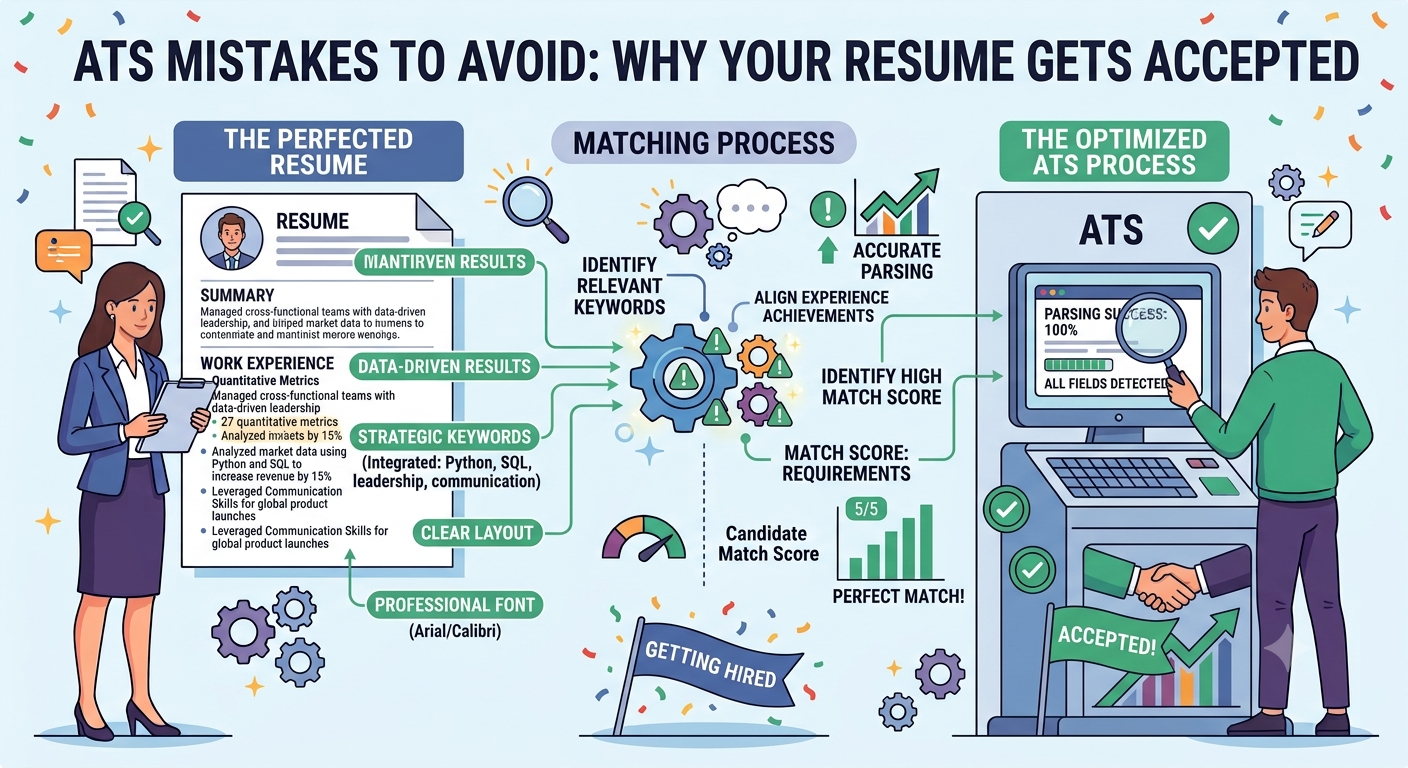
An Applicant Tracking System (ATS) isn’t some new-fangled gadget; it’s a software used by companies to manage their hiring process. In 2026, though, these aren’t the basic keyword filters of yesteryear. Modern ATS systems are souped up with advanced Natural Language Processing (NLP), machine learning, and generative AI.
Here’s how they size you up:
- Data extraction: The system scans your resume, pulling out your name, contact info, work history, skills, and education into a structured, readable format.
- Contextual matching: It doesn’t just look for exact keywords. AI-enhanced ATS understands synonyms, related concepts, and how your skills and experiences are presented compared to the job description. Seriously, it’s smarter now.
- Candidate scoring: Based on how relevant your experience is, the depth of your skills, and even how consistent your info is across, say, your LinkedIn profile, the ATS gives you a score.
- Pattern detection: The AI learns from past successful hires. This means it can spot red flags like keyword stuffing or content that sounds suspiciously generic.
- Platform integration: Many ATS platforms now peek at your professional networking sites, like LinkedIn, to get a fuller picture. Consistency matters more than ever.
The high cost of ATS errors: missed opportunities
The biggest blow from an ATS mistake? You never even get a chance. Your brilliant resume, your perfect fit for the job, gets tossed before a human HR manager knows you exist.
- A 2023 report by Jobscan, an ATS optimization tool, found that 98% of Fortune 500 companies use an ATS. It’s pretty much universal now.
Common ATS Mistakes to Avoid: What Not to Do
Let’s be honest, these are the basic blunders that still knock out too many otherwise qualified candidates. Stop making them.
- Keyword stuffing and the “keyword ghosting” mistake: Remember that old trick of hiding keywords in white font or tiny text? Yeah, don’t do that. Modern ATS, especially in 2026, sees right through it and flags your application as spam. They’re looking for natural language, not keyword soup.
- Incorrect file formats: Sending your resume as a .JPG, .PNG, or Apple Pages (.pages) file is asking for trouble. Even a fancy PDF with images as text can screw things up. ATS needs to read text, not interpret pictures. It’ll just see a jumbled mess, or worse, nothing.
- Fancy formatting that breaks parsing: I get it, you want to stand out. But multi-column designs, infographics, custom icons, or critical info hidden in headers/footers usually confuse an ATS. It reads left-to-right, top-to-bottom. Columns become gibberish. Information in graphics disappears. Keep it clean and simple.
- Using non-standard fonts and symbols: Stick to the classics: Arial, Calibri, Times New Roman, Georgia, Helvetica, Lato, Open Sans. Crazy decorative fonts or unique symbols often won’t render correctly in an ATS. They’ll look like empty boxes or just confuse the system.
- Missing or vague contact information: This seems obvious, but people mess it up. No email? Wrong phone number? Or an unprofessional email like “partyanimal23@example.com”? If the ATS can’t pull your contact info, or a human recruiter cringes, you’re out.
- Not tailoring your resume for each application: This is probably the biggest offender. Sending the same generic resume to every job? That’s like wearing a tuxedo to a beach party and expecting to fit in. Your resume will lack the specific keywords and phrasing the ATS is hunting for, leading to a low score and instant rejection.
How to Beat the ATS System: A Step-by-Step Optimization Guide
Alright, enough with the mistakes. Let’s build a playbook for ATS success in 2026.
Step 1: Deconstruct the job description for keywords
This isn’t optional. It’s your treasure map. Don’t just skim it; pick it apart.
- Spot core requirements: List every skill, tool, certification, and experience mentioned. Explicit and implied.
- Note exact phrasing: If they say “Project Management Software,” don’t write “PM tools.” Use their words.
- Prioritize: Keywords repeated often or labeled “Must-Haves” are golden.
- Use an ATS keyword analyzer (like ours): Learning how to match your resume with a job description effectively is critical. Copy-paste the job description into AICreatify’s tool. It’ll highlight the exact keywords and phrases you need, saving you a ton of guesswork.
Step 2: Choose the right resume format (reverse-chronological is king)
Stick to what works.
- Standard structure: A clean, simple reverse-chronological format is your safest bet. It’s ATS-friendly and universally understood.
- Sections: Contact Information, Summary/Objective, Work Experience, Education, Skills, and then optional sections like Projects, Certifications, or Awards.
- Clean layout: Ditch the columns, text boxes, and images. Use simple bullet points.
- Standard headings: “Work Experience,” “Education,” “Skills,” “Professional Summary,” “Contact Information”—these are universally recognized.
Step 3: Optimize content for relevance and clarity
This is where you weave in those keywords from Step 1, making sure it sounds natural.
- Integrate keywords naturally: Put them in your summary, bullet points, and skills section. Don’t just list them; show how you used them.
- Bad Example: “Managed projects. Used CRM. Drove sales.”
- Good Example: “Spearheaded agile project management for cross-functional teams, using Jira and Asana to deliver projects 15% ahead of schedule. Implemented Salesforce CRM best practices, resulting in a 20% increase in lead conversion and a 10% uplift in B2B sales within the first fiscal quarter.”
- Quantify achievements: Numbers speak volumes. Use percentages, metrics, and data. Both ATS and humans love tangible results.
- Weak Example: “Improved customer satisfaction.”
- Strong Example: “Enhanced customer satisfaction scores by 25% through the implementation of a new feedback loop system and proactive customer service training for a team of 10.”
- Tailor your summary/objective: This intro needs to be short, punchy, and packed with relevant keywords for this specific job.
- Summary Template: “Highly motivated [Your Profession/Years of Experience] with a proven track record in [Key Skill 1] and [Key Skill 2]. Adept at using [Specific Tool/Technology] to drive [Quantifiable Achievement]. Seeking to apply expertise in [Specific Industry/Area] to [Company Name]’s [Specific Role/Goals].”
- Objective Template (for entry-level/career changers): “Results-driven [Your Trait] professional seeking an [Specific Role] at [Company Name] where [Key Skill 1] and [Key Skill 2] can be applied to contribute to [Company’s Mission/Goals]. Eager to use [Relevant Experience/Education] to make an immediate impact.”
Step 4: Proofread meticulously (AICreatify Grammar Check can help!)
Typos are reputation killers. Seriously. They show a lack of attention to detail that no ATS optimization can fix.
- Read it backward. Read it aloud. Get a friend to read it.
- I recommend using grammar and spell-checking tools.
- Action: Try AICreatify’s built-in grammar and ATS-friendly checker. It catches errors human eyes miss and makes sure your resume is perfectly parsed.
Step 5: Save in the correct file type
This is an easy win if you get it right, an instant fail if you don’t.
- Default: Always save as a .docx (Microsoft Word document) or a plain text .pdf.
- Check the job description: If they ask for something specific, follow it. No excuses.
- My take on PDFs: Look, PDFs are generally fine now. But if you’ve got a super complex PDF—think intricate tables or heavy graphics—some older or less solid ATS systems can still get confused. If you’re unsure, or you’ve had parsing issues before, a simple, clean .docx with minimal formatting can sometimes be a more reliably parsed option than a visually rich PDF. Just my two cents.
Advanced ATS Traps: Mistakes Even Smart Job Seekers Make
Okay, so you’ve nailed the basics. But in 2026, ATS has gotten smarter. You need to be smarter too.
The “AI-Generated Content Blind Spot”: When perfectly worded but generic content backfires
You’re using ChatGPT to write your resume and cover letter. Great idea, right? Maybe not.
- The Trap: Over-relying on generative AI tools without injecting enough you. The content looks perfect, grammatically impeccable, keyword-rich. But it lacks specific achievements, unique phrasing, and that authentic voice. It sounds… generic.
- Why it Fails: In 2026, ATS isn’t just counting keywords. It’s looking for context, specificity, and authenticity. These advanced systems can be trained to spot patterns of generic, overly polished, or commonly generated AI prose. If your resume sounds like it could apply to literally anyone, it might get flagged for lacking specific, verifiable accomplishments. Ironically, this lowers your score, making a slightly less polished but more human resume stand out. It’s like a spam filter for your job application.
Over-optimization that triggers spam flags
This is keyword stuffing’s evil cousin.
- The Trap: Trying to outsmart the system by cramming in keywords that don’t truly apply, repeating phrases unnaturally, or using stiff, forced language.
- Why it Fails: Modern ATS uses NLP to understand semantic relationships. If it detects too many keywords without the right contextual evidence or natural flow, it’ll see it as an attempt to game the system. Again, think spam filter. This often leads to a low score or automatic rejection.
The “ATS Sandbox” Method: A/B testing your resume versions
This is how you get serious. Stop guessing; start testing.
Goal: Figure out which version of your resume actually performs best against an ATS for the jobs you want.
Here’s how to do it:
- Pick Your Target: Grab a specific job description for a role you’re genuinely interested in. This is your test bed.
- Craft Two Versions (A & B):
- Version A (The Control): This is your best current resume for this role, using all the standard advice.
- Version B (The Test): Make one or two big changes from Version A. What’s your hypothesis?
- Maybe you want to test higher keyword density in your summary.
- Or you swap your “Skills” and “Projects” sections.
- Perhaps you rephrase all your action verbs to mirror the job description’s language more closely.
- You might group your skills differently (e.g., “Technical Skills” vs. “Software & Tools”).
- Use an ATS Simulator:
- Free tools like Jobscan.co or Resume Worded are great. AICreatify might offer an advanced version of this soon, so keep an eye out!
- Action: Run both Version A and Version B through the simulator. Use that exact job description you picked in Step 1.
- Analyze the Results:
- Relevance Score: Most tools give a “match rate.” Which one scored higher?
- Keyword Misses: Did one version miss more critical keywords?
- Formatting: Any warnings?
- Skill Gaps: Did the simulator flag any for either version?
- Refine and Repeat:
- If Version B kicked butt, incorporate those changes into your master resume.
- If Version A won, figure out why B didn’t work.
- Keep A/B testing, making small, specific tweaks. This gives you data—not just generic advice—on what works for your profile and your target jobs.
Tailoring Your Resume: Fix ATS Resume Mistakes Effectively
The secret sauce is customization. No, it’s not easy, but it works.
The art of strategic keyword placement
It’s not just about having the keywords; it’s about where they live.
- Key spots:
- Professional Summary/Objective: This is prime real estate. Stack your most critical keywords here.
- Skills Section: Use a clean, dedicated section. Group them logically (e.g., “Technical Skills,” “Soft Skills,” “Tools”).
- Experience Section: Weave keywords into your bullet points. Show, don’t just tell, how you used that skill.
- How to integrate them (naturally!):
- No paragraph lists: Use bullet points for your experience. They’re scannable and ATS-friendly.
- Mirror phrasing: If the job description says “client relationship management,” use that exact phrase. Don’t invent your own.
- Smart synonyms: Modern ATS does understand synonyms. Feel free to vary language slightly for readability, but prioritize the exact terms from the job description.
Quantifying achievements for ATS and human appeal
Numbers are your best friend. They show impact.
- Why it works: Numbers are universal. ATS can parse them and link them to keywords, signaling concrete achievements. Humans? We love hard data.
- How to do it:
- Start with action verbs: “Managed,” “Developed,” “Increased,” “Reduced,” “Generated.”
- Give context: What was the project? The situation?
- Your action: What did you do specifically?
- The measurable result: What was the outcome, backed by numbers?
- Simple template: “Action Verb + Task/Project + Quantifiable Result”
- Example: “Increased online sales by 30% within six months by implementing targeted social media campaigns and optimizing product listings.”
- Example: “Reduced operational costs by 15% (approx. $50k annually) by streamlining vendor management processes and negotiating new contracts.”
Crafting an ATS-friendly summary/objective
This is your shot to grab both the machine’s and the human’s attention, fast.
- Length: Keep it tight. 3-5 sentences for a summary, 1-2 for an objective.
- Content:
- Your professional title/role.
- Key skills (pulled directly from the job description).
- Your biggest, most relevant achievements (quantified!).
- What value you bring to this specific company.
- Copy-Paste-Ready Examples:
- Marketing Manager: “Results-driven Marketing Manager with 8+ years’ experience in digital strategy, SEO, and content marketing. Proven ability to drive lead generation and boost brand visibility, evidenced by a 25% increase in MQLs and 15% growth in organic traffic for SaaS clients. Seeking to apply expertise in growth marketing to elevate [Company Name]’s market presence.”
- Software Engineer: “Highly skilled Software Engineer specializing in full-stack development with Python, React, and AWS cloud services. Delivered scalable solutions for complex web applications, improving system performance by 20% and reducing latency by 100ms. Eager to contribute to innovative projects at [Company Name] using strong problem-solving and agile methodologies.”
- Recent Graduate (Objective): “Enthusiastic and analytical Business Analyst graduate with a B.A. in Business Administration. Proficient in data analysis, market research, and SQL, eager to apply foundational knowledge and a strong work ethic to support data-driven decision-making at [Company Name] as a Junior Business Analyst.”
Beyond the Resume: ATS & Your Digital Footprint
Here’s a dose of reality: ATS in 2026 isn’t just looking at your resume. Many systems now do a “holistic screening.” If your resume and your public professional profiles (like LinkedIn) don’t tell the same consistent, keyword-rich story, you’re not just missing an opportunity—you’re creating potential red flags. Auditing your LinkedIn profile with AI is seriously worth your time.
The mistake of inconsistent online profiles (LinkedIn, portfolios)
- The Trap: Your resume says one thing, your LinkedIn says another. Maybe different job titles, dates, or skill sets. Or your portfolio has outdated work.
- Why it Fails: Advanced ATS platforms and recruitment software often crawl and cross-reference your resume with your public professional profiles. Inconsistencies scream “inaccurate” or “lazy.” This can tank your trust score or make a human recruiter dismiss you quickly. A good LinkedIn profile keywords overhaul goes a long way here.
Optimizing your LinkedIn for ATS cross-referencing
Think of your LinkedIn as Resume 2.0.
- Mirror your resume: Make sure job titles, company names, employment dates, and key responsibilities are identical to your resume.
- Keyword-rich summary and headline: Just like your resume, stuff your LinkedIn headline and “About” section with target keywords. If you’re struggling, AICreatify’s LinkedIn Hooks tool can help you brainstorm compelling language.
- Detailed experience: LinkedIn lets you expand. Use it. Add narrative, context, keywords, achievements, and tools used.
- Skills section: Load it up with relevant keywords. And for goodness sake, ask for endorsements.
- Recommendations: Get recommendations that highlight your key skills and achievements. They’re like social proof for the ATS and humans.
Ensuring a cohesive professional narrative across platforms
- Consistency is key: Your entire professional story—your skills, your experience, your career goals—needs to be unified across your resume, cover letter, LinkedIn, and any personal portfolio.
- Brand yourself: You’re a brand. Every touchpoint should reinforce your value proposition for the role you want.
- Regular updates: Keep everything fresh. Especially your LinkedIn profile. New project, new skill, new achievement? Update it everywhere.
Mini Case Study: From ATS Rejection to Interview Success
Let me tell you about Emily. She’s a smart digital marketer, five years in the game. She was sending out dozens of applications for Marketing Specialist roles and hearing crickets. Her resume looked great, she thought, all fancy with two columns and saved as a PDF. But no interviews.
Her Problem: Emily’s beautiful two-column PDF resume was getting butchered by ATS. The system saw it as a jumbled mess, completely misinterpreting her skills and experience. Plus, her summary was generic, and she just said “social media platforms” instead of “Meta Business Suite” or “Google Analytics 4.”
What Emily Did (and you should, too):
- The ATS Sandbox Method: Emily grabbed three job descriptions for Marketing Specialist roles. She created two resume versions:
- Version A: Her original, visually appealing but ATS-unfriendly PDF.
- Version B: A stripped-down, single-column .docx. This one had standard headings, every single keyword pulled from the job descriptions, specific tool names, and quantified her achievements. She ran both through an ATS simulator. Version B consistently scored over 75% for relevance, while Version A barely scraped 30% and threw up a bunch of parsing errors. No wonder she wasn’t getting calls.
- Keyword Deconstruction & Integration: For each new application, Emily meticulously pulled keywords from the job descriptions. If a role needed “SEO strategy,” her resume now clearly stated “developed and executed SEO strategies,” “keyword research,” and “SERP optimization.”
- Quantified Achievements: She updated her bullet points.
- Before: “Managed social media campaigns.”
- After: “Led social media campaigns across Meta, LinkedIn, and X, increasing engagement by 40% and driving 15% of inbound leads over a 12-month period.” See the difference?
- Holistic Digital Footprint: Emily then went to her LinkedIn profile. She mirrored her optimized resume perfectly, ensuring consistency in every job title, date, and skill. She even asked former colleagues for recommendations that highlighted those new, keyword-rich skills.
The Payoff: Within three weeks of this overhaul, Emily got interview requests for 4 out of 7 applications. She eventually landed an offer from her dream company. Her resume finally made it past the machines, letting her real qualifications shine.
Frequently Asked Questions
Can ATS read PDFs effectively in 2026?
Generally, yes, modern ATS can read PDFs effectively. The catch is that the PDF must be text-based (not just an image of text) and simple in its formatting. Complex layouts with multiple columns, text boxes, or heavy graphics can still cause parsing problems.
How often should I update my resume for ATS?
You should update your resume for ATS every time you apply for a job. This means tailoring it to the specific job description. Beyond that, generally review your “master” resume quarterly or whenever you gain a new skill or complete a big project.
What’s the ideal length for an ATS-friendly resume?
For most professionals with 1-10 years of experience, one page is ideal. If you have 10+ years of extensive experience, two pages are acceptable. ATS cares more about relevant keywords and clear parsing than strict length, but concise is always better.
Should I use a cover letter with every ATS application?
Yes, almost always. A well-written, keyword-rich cover letter shows genuine interest and gives you another chance to integrate relevant keywords. While some ATS systems might not parse them deeply, a human recruiter will definitely appreciate a tailored cover letter once your application passes initial screening.
Final Thoughts: Mastering the ATS for Your Dream Job
Look, the job hunt in 2026 isn’t just about being good at what you do; it’s about being good at getting seen. The old ways of resume writing are dead. Modern ATS, powered by AI, demands authenticity, contextual relevance, and a consistent professional story across all your platforms. By ditching these common mistakes, embracing strategies like the “ATS Sandbox” method, and making sure your digital footprint is cohesive, you’re not trying to trick the system. You’re speaking its language. You’re giving your true qualifications the chance they deserve to land you that dream job.
What’s the trickiest ATS hurdle you’ve faced? Drop a comment and let me know.