Your LinkedIn posts are landing with a thud. Crickets instead of comments. Zero engagement, zero leads. Sound familiar?
The problem isn’t your message. It’s your opening line.
In the relentless feed of 2026, if you don’t grab attention in milliseconds, you’re invisible. No algorithm boost, no audience, no impact. You’re just another scroll.
But what if a formula existed? A predictable way to stop the scroll, ignite engagement, and drive real results?
It does.
I’ve cracked the code. As the Head of Growth at AICreatify, I’m constantly dissecting what truly works for top performers. I’ve distilled it into one powerful framework: C.A.T.C.H.
This isn’t theory. This is a battle-tested blueprint. Get ready to transform your LinkedIn game and turn every post into a conversion machine.
Why a Powerful LinkedIn Hook is Non-Negotiable in 2026
Forget “nice-to-have.” A killer LinkedIn hook is your digital lifeline. It’s the difference between shouting into the void and starting a movement.
The LinkedIn Algorithm’s Gaze: Grabbing Attention Fast
The algorithm is ruthless. It demands instant engagement. If your first few lines don’t scream “STOP!”, you’re dead in the water.
Research shows those first 2-3 lines are make-or-break. Users decide in 3 seconds if they’ll read on. Posts that nail this see 20-50% higher dwell time and “See More” clicks. That’s pure algorithm fuel, boosting your organic reach.
Beyond the Fold: Hooking Your Audience Before They Scroll Past
LinkedIn’s feed is a high-speed chase. A weak hook? You’re scrolled past. Forever.
A compelling hook drastically cuts scroll-past rates. Posts with engaging first lines can increase the chance of a user pausing by up to 70%. That’s not just a vanity metric; it’s a direct shot at initial impressions and potential engagement.
The ROI of Engagement: Why Every Click Matters
LinkedIn isn’t just a social network. It’s the #1 social channel for B2B lead generation, period. Over 80% of all B2B social media leads come from here.
Every like, comment, or share on a well-hooked post builds brand visibility. It establishes authority. It slashes your cost per qualified lead (CPL). Businesses rocking organic LinkedIn strategies report a 2-5x higher ROI than other platforms for B2B. It all starts with that initial spark of interest.
Deconstructing the Anatomy of an Irresistible Hook
So, what makes a hook actually *hook*? It’s not magic. It’s psychology.
The 3-Second Rule: What Makes a Hook Effective?
Your hook’s job is simple: create enough intrigue to earn the “See More” click. It must deliver immediate value, provoke thought, or spark curiosity. Fast.
Key Psychological Triggers: Curiosity, Value, and Relatability
Hit these, and you win.
- Curiosity: Ask a question, hint at a secret, challenge a belief. Make them need to know more.
- Value: Promise an insight, a solution, a shortcut. Show them what’s in it for them.
- Relatability: Acknowledge a shared struggle, an unspoken truth, a universal aspiration. Make them feel understood.
Differentiating Hooks from Clickbait: Authenticity Matters
Big difference. Clickbait promises the world and delivers nothing. A good hook promises *value* and then *delivers it* in the rest of your post. Authenticity builds trust. Clickbait erodes it.
The “C.A.T.C.H.” LinkedIn Hook Formula Revealed
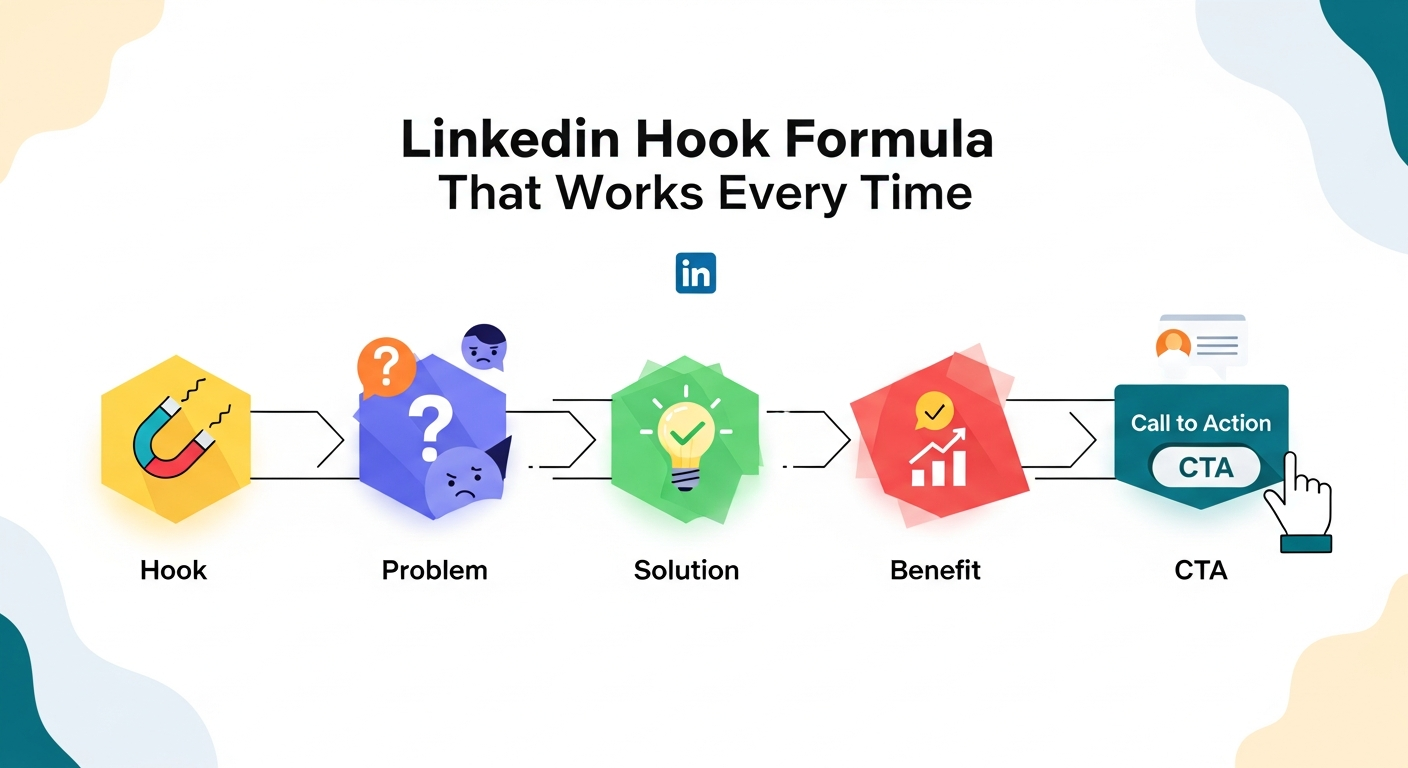
This is it. My proprietary framework for hooks that grab attention and drive action. Memorize it. Live by it.
- Controversy/Challenge: Start with a bold statement. Ask a challenging question. Drop a surprising statistic. Shake things up.
- Agitate/Acknowledge: Relate directly to a common pain point. Tap into an aspiration. Voice an unspoken truth your audience feels deeply.
- Thrive/Transform: Hint at the solution. Offer a major insight. Promise a positive outcome that improves their situation.
- Create Urgency/Curiosity: Make them feel they must read more, right now. Build anticipation. Don’t give everything away.
- Humor/Humanity: Inject your personality. Share a relatable anecdote. A touch of humor (optional) makes you memorable and human.
Growth Hackers & Brands in Action: Real-World C.A.T.C.H. Examples
The proof is in the results. See how top performers use these principles to dominate LinkedIn. These aren’t just pretty words; they’re revenue drivers.
Case Study 1: Justin Welsh – The “Agitate & Transform” Master for Personal Branding & Product Sales
Justin Welsh is a LinkedIn legend. His secret? Relentless ‘Agitate’ and ‘Transform’ hooks. He identifies a painful problem, then immediately offers a promise of solution. He often throws in a ‘Controversy’ to challenge norms.
Example Hook Analysis:
- Actual Hook: “Most people fail to build an audience on LinkedIn because they’re selling too early. Here’s the 3-step framework I used to gain 100k followers in 12 months without ever ‘asking’.”
C.A.T.C.H. Breakdown:
- (C)ontroversy/Challenge: “Most people fail… because they’re selling too early.” (Boom. Challenges common wisdom).
- (A)gitate/Acknowledge: Hits the pain of slow growth, ineffective selling. It resonates.
- (T)hrive/Transform: Promises a “3-step framework” and rapid growth (“100k followers”). Clear benefit.
- (C)reate Urgency/Curiosity: “Here’s the… without ever ‘asking’.” (Implies a secret, a smarter way).
- (H)umor/Humanity: (Subtle, in his candid, direct style).
Growth Impact: This style built Justin a 1M+ follower empire. It drives massive sales for his digital products. His posts routinely get thousands of likes, hundreds of comments, and high conversion rates (5-7%) from LinkedIn engagement to paid offerings. That’s real ROI.
Case Study 2: HubSpot – Data-Driven “Challenge & Curiosity” for Lead Generation
HubSpot, the B2B SaaS powerhouse, knows data. They weaponize it. Their hooks challenge assumptions with stats, then pique curiosity for gated content. They master (C)ontroversy/Challenge and (C)reate Urgency/Curiosity.
Example Hook Analysis:
- Actual Hook: “Only 15% of marketers fully understand Gen Z’s buying habits. Are you missing out on the next generation of customers? Our latest report reveals what *actually* works.”
C.A.T.C.H. Breakdown:
- (C)ontroversy/Challenge: “Only 15% of marketers…” (Creates F.O.M.O., highlights a huge knowledge gap).
- (A)gitate/Acknowledge: “Are you missing out…?” (Directly addresses a potential business threat).
- (T)hrive/Transform: “Our latest report reveals what *actually* works.” (Promises exclusive, actionable insight).
- (C)reate Urgency/Curiosity: “What *actually* works” (Emphasizes the report’s unique value).
Growth Impact: This fuels HubSpot’s lead generation engine. Posts like this, especially with carousel documents (which see 1.8x higher engagement), hit 8-12% click-through rates (CTR) to lead magnets. Far above industry averages. These aren’t just clicks; they’re qualified leads, contributing to billions in revenue.
Case Study 3: Gong.io – “Statistic-Powered Curiosity” for Product-Led Growth
Gong.io, the revenue intelligence platform, uses *their own proprietary data* to create shocking, insightful hooks. It’s (C)ontroversy/Challenge driven by numbers, followed by (C)reate Urgency/Curiosity that positions their platform as the source of truth. This is product-led growth at its finest.
Example Hook Analysis:
- Actual Hook: “Sales teams that ask ‘What keeps you up at night?’ close 30% more deals. The old ‘pain point’ question is dead. Here’s why and what to ask instead.”
C.A.T.C.H. Breakdown:
- (C)ontroversy/Challenge: “Sales teams that ask ‘What keeps you up at night?’ close 30% more deals.” (Specific, surprising stat. Challenges sales norms). “The old ‘pain point’ question is dead.” (Bold, contrarian statement).
- (A)gitate/Acknowledge: Implies outdated tactics, missed opportunities for sales pros.
- (T)hrive/Transform: Hints at a better way, “what to ask instead.”
- (C)reate Urgency/Curiosity: “Here’s why and what to ask instead.” (Promises immediate, actionable insight).
Growth Impact: Gong.io’s data-driven hooks drive massive brand awareness. Their posts get 3-5x higher engagement than average B2B content. This translates directly to increased demo requests and MQLs who already understand Gong’s unique value. It’s a cornerstone of their product-led growth strategy.
Real-World Use Cases: Applying the C.A.T.C.H. Formula
The C.A.T.C.H. formula isn’t just for big brands. It’s for *everyone* looking to make a splash on LinkedIn.
For Job Seekers: Landing Your Dream Role
- Example: “The #1 mistake job seekers make? Relying on résumés. I landed my dream role in 3 weeks by flipping the script. Here’s the unconventional strategy nobody tells you.” (Challenges, agitates, transforms, creates curiosity).
For Thought Leaders: Amplifying Your Expertise
- Example: “Everyone’s talking about ‘AI integration.’ But 90% are missing the *real* threat to marketing teams. It’s not AI. It’s THIS. And you need to prepare now.” (Controversy, agitates, creates urgency).
For Sales Professionals: Generating Qualified Leads
- Example: “Still cold calling? You’re leaving 7-figure deals on the table. My team closed 5 new clients last month using a LinkedIn ‘warm-up’ strategy that took 10 minutes a day. Want the playbook?” (Controversy, agitates, transforms, creates urgency).
For Content Creators: Driving Traffic & Engagement
- Example: “My latest blog post flopped. Miserably. So I scrapped everything, used a new hook formula, and got 5,000 views in 24 hours. Here’s how I did it (and the exact formula).” (Humanity, agitates, transforms, creates curiosity).
Step-by-Step Walkthrough: Crafting a C.A.T.C.H. Hook from Scratch
Ready to build your own scroll-stopper? Follow these steps.
Step 1: Define Your Goal and Target Audience
Who are you talking to? What do you want them to *do* after reading? Be crystal clear. Knowing your audience’s pains and aspirations is your secret weapon.
Step 2: Brainstorm Core Ideas Using the C.A.T.C.H. Elements (Mind Mapping)
Pick your topic. Now, for each C.A.T.C.H. letter, brainstorm ideas. Don’t censor yourself – just get everything down.
- C: What’s a bold statement you can make? A surprising fact that challenges assumptions?
- A: What’s their deepest pain point related to this topic? What’s a secret desire or unspoken frustration they feel?
- T: What solution or transformative insight can you offer? What positive outcome will they get?
- C: How can you make them *need* to know more? What can you hint at without giving away the farm?
- H: Any personal story or relatable anecdote? A touch of humor to make it memorable?
Step 3: Draft Your Initial Hook Iterations (Focus on variety)
Don’t settle for the first one. Write 5-10 variations. Play with different C.A.T.C.H. elements. Mix and match. Combine a “Controversy” with a “Transform,” or an “Agitate” with “Curiosity.”
Step 4: Refine and Test for Maximum Impact (Read aloud, get feedback)
Read your hooks aloud. Do they flow? Are they punchy? Would *you* stop scrolling for them? Get a trusted peer to give feedback. Which one genuinely stops *their* scroll?
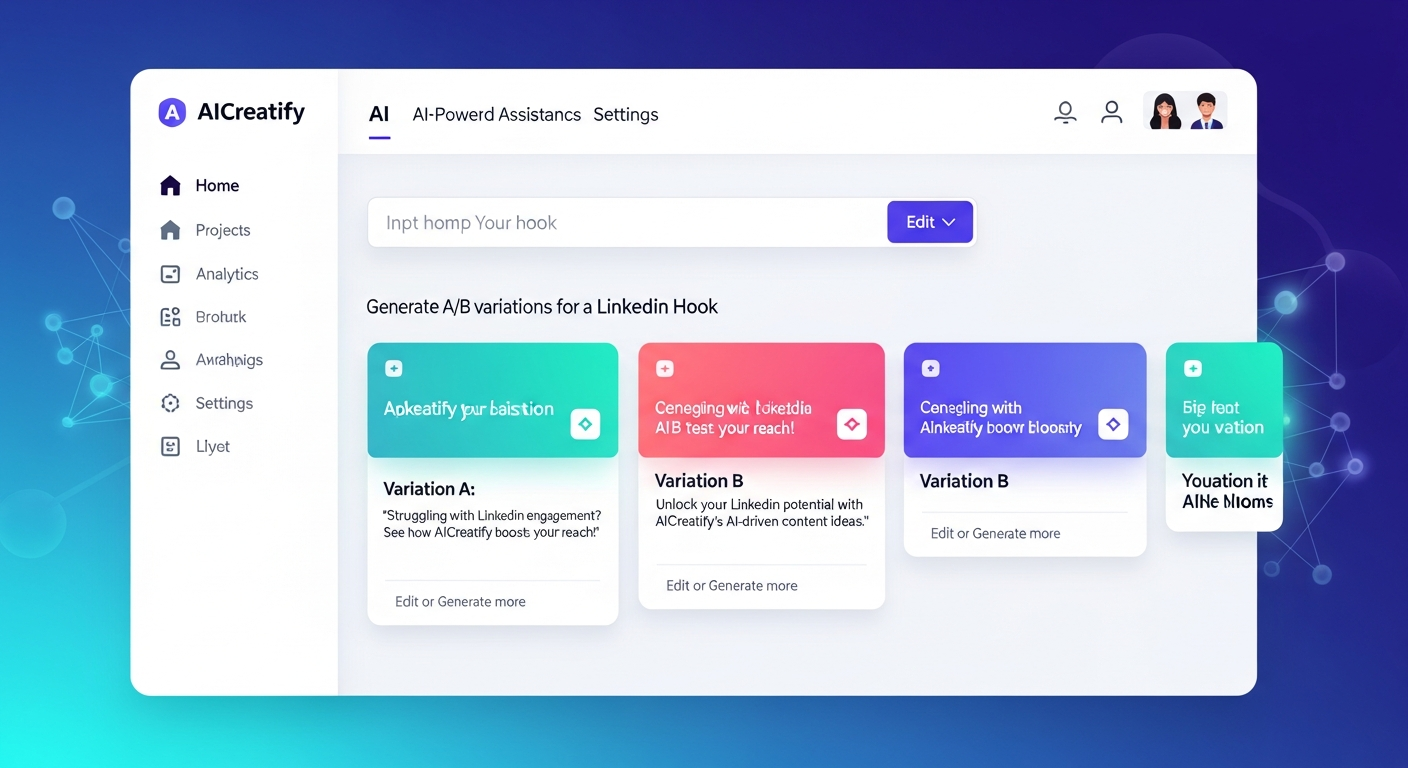
Need a faster way to generate killer hooks? Try AICreatify’s LinkedIn Hooks for Founders tool for free. It’s your unfair advantage.
The “Hook-to-Lead” LinkedIn Velocity Campaign: A Concrete Use Case for AICreatify Pro
Let’s put this into action. Here’s a 30-day blueprint for generating high-quality leads using C.A.T.C.H. and AICreatify.
Campaign Goal: Generate 50+ Marketing Qualified Leads (MQLs) for “AICreatify Pro” (our advanced AI content generation and optimization platform for B2B marketers) within 30 days.
Target Audience: Mid-to-senior level B2B Marketing Managers, Content Strategists, and Growth Marketers struggling with content velocity and engagement.
Phase 1: Hyper-Targeted Audience & Pain Point Deep Dive (Days 1-3)
Beyond demographics, dig deep. What are their *unspoken* daily content creation frustrations? What keeps them up at night regarding LinkedIn strategy?
- Example Pain Point: “Manually A/B testing LinkedIn hooks across multiple client accounts is tedious, time-consuming, and lacks scalability. My team is burning out.”
- AICreatify Integration: Use AICreatify’s prompt engineering features. Ask it: “Generate 10 specific, hidden pain points for a B2B marketing manager struggling with LinkedIn engagement and content creation efficiency.” This gets you specific, high-impact insights fast.
- Data Focus: Benchmark current content production rates vs. desired rates within your target audience’s industry. This fuels your “Transform” element later.
Phase 2: C.A.T.C.H. Hook & Lead Magnet Development (Days 4-7)
Time to craft those irresistible hooks and a high-value offer they can’t ignore.
- Execution: Develop 3-5 high-impact C.A.T.C.H. hooks, each targeting a specific pain point identified in Phase 1.
- Hook 1 (Controversy/Agitate): “Stop writing LinkedIn hooks like it’s 2022. Your ‘safe’ openers are actually killing your organic reach. Here’s why 90% of your posts aren’t performing – and what to do instead.”
- Hook 2 (Agitate/Transform): “Feeling the content creation burnout? Imagine automating 70% of your LinkedIn hook generation and seeing a 2X engagement boost in 30 days. It’s not a fantasy – it’s possible with AI.”
- Lead Magnet: Create a compelling, short guide: “The B2B Marketer’s AI-Powered Toolkit: 5 Advanced LinkedIn Hook Templates That Convert.” Ensure this has a sleek, high-converting landing page.
- AICreatify Integration: Input your topic and desired C.A.T.C.H. elements. For example, “Generate 3 controversial LinkedIn hooks about content automation for B2B marketing managers, promising a 2X engagement boost.” Refine the output until it shines.
- Data Focus: Set ambitious CTR expectations for your lead magnet link. Aim for 10-15% from engaged post readers.
Phase 3: Multi-Format Content Distribution (Days 8-25)
Don’t just post. Distribute strategically. Leverage varied formats, always linking to your lead magnet (the first comment is key!).
- Week 1 (Text-Based Posts): Publish 3-4 text posts using variations of Hook 1 & 2. Keep paragraphs short, use emojis for visual breaks.
- Practical Tip: Place your lead magnet link in the *first comment* with a clear micro-CTA (e.g., “Grab the free toolkit here: [Link]”). Make sure to reply to *all* early comments to signal engagement to the algorithm.
- Week 2 (Carousel/Document Posts): Create 2-3 visually striking carousels. The first slide *is* your C.A.T.C.H. hook. Subsequent slides deliver quick, actionable value, leading to a final CTA slide with the lead magnet link.
- Practical Tip: Carousels consistently show 1.8x higher engagement. Design your first slide’s hook to be visually dominant and instantly readable.
- Week 3 (Native Video/Audio Event Promo): Publish a short (60-90 sec) native video. Start with a verbal C.A.T.C.H. hook in the first 3 seconds. Elaborate briefly, then direct viewers to the link in comments for the lead magnet or an upcoming webinar.
- Data Insight: Native video on LinkedIn typically gets 3x higher engagement than external video links. Use a strong hook both visually and verbally.
- AICreatify Integration: Use AICreatify to generate quick variations for carousel slide text, video scripts, or even ad copy for boosted posts. It helps maintain velocity without sacrificing quality.
Phase 4: Engagement, Amplification & Optimization (Ongoing)
Your work isn’t done after hitting ‘post’. This is where real growth happens. Engage. Amplify. Optimize.
- Execution: Actively monitor comments and messages. Engage authentically and add further value in your replies.
- Practical Tip: Respond to *all* comments within the first 60 minutes. This signals value to the algorithm, boosting reach and engagement.
- Team Amplification: Rally your sales and marketing teams. Encourage authentic comments, shares, and reactions (not just likes).
- A/B Testing: Use UTM parameters on *all* lead magnet links. Track performance by hook variation, content format, and individual post to understand what resonates most.
- Data Focus:
- Track CTR from post to lead magnet landing page. Target >10%.
- Track Conversion Rate (CR) from landing page visit to MQL. Target >15%.
- Monitor LinkedIn Analytics: impressions, unique views, engagement rate, follower growth.
- Analyze which C.A.T.C.H. element resonated most (e.g., did “Controversy” hooks consistently outperform “Agitation” hooks for your audience?).
- Optimization Loop: Use your A/B test results to refine future hooks. If “Controversy” works, generate more using AICreatify’s LinkedIn Hooks tool. Continuously adapt your strategy based on real-world data.
Common Pitfalls: What NOT to Do with Your LinkedIn Hooks
Avoid these traps. They’ll kill your engagement faster than a bad cup of coffee.
Being Vague, Generic, or Overly Promotional
“Great article!” is not a hook. “Boost your sales!” is too generic to stop anyone. “Buy my product!” is a hard pass. Be specific. Be intriguing. Don’t sell in the hook; sell the *idea* of value.
Ignoring Your Audience’s Needs and Interests
You’re not writing for yourself. You’re writing for *them*. If your hook doesn’t speak to *their* pains, *their* aspirations, or *their* challenges, it fails. Period.
Over-optimization, Clickbait, or Misleading Statements
The algorithm is getting smarter. Your audience is too. Don’t use sensationalized, empty promises that don’t deliver. A good hook promises value and then *delivers* that value in the rest of your post. Authenticity and trust are paramount.
Neglecting Visuals and the Rest of the Post
The hook is just the opener. A dazzling hook paired with a bland visual or a weak main body will still kill the post’s overall performance. The whole package matters.
Maximizing Your LinkedIn Post’s Reach Beyond the Hook
The hook gets them in. These tactics keep them there and amplify your message.
Engaging Visuals, Carousels, and Rich Media
Always use native images or videos. They outperform external links significantly.
- Practical Tip: Carousels (document posts) are gold for presenting complex information in a digestible format; they’ve shown 1.8x higher engagement. For video hooks, capture attention in the first 3 seconds with movement, a surprising visual, or a bold verbal statement.
Strategic Hashtag Usage (Beyond the Obvious)
Don’t just use #marketing. Go deeper and smarter.
- Practical Tip: Mix broad (#Marketing), niche (#SaaSMarketing #GrowthHacks), and proprietary (#AICreatifyTips) hashtags. Research trending, relevant tags. Aim for 3-5 *highly relevant* hashtags. Need help finding the best ones? Try AICreatify’s Hashtag Generator.
The Art of the Call-to-Action (Soft vs. Hard CTAs)
The algorithm prefers users stay on LinkedIn. Work *with* it.
- Practical Tip: For lead generation, put your hard CTA (link) in the *first comment*. In the main post, use a softer, engaging CTA: “What are your thoughts on this?” or “Dive deeper into this framework and tell me what you find.” This encourages on-platform interaction.
The Power of the First Comment: Sparking Discussion
Your first comment is a “second hook” and a crucial engagement tool. Don’t waste it.
- Practical Tip: Beyond just dropping the link, add a follow-up question. Drop a mini-insight. Relate it back to your hook to spark conversation immediately and keep the comments flowing.
Consistency and Engagement with Others’ Content
The algorithm rewards activity. Be an active community member, not just a broadcaster.
- Practical Tip: Engage with other posts (especially those from your target audience and industry leaders) for 15-20 minutes *before* and *after* you post. This “warms up” your profile, signals to the algorithm that you’re an active participant, and boosts your post’s visibility.
Practical Execution Steps for C.A.T.C.H. Mastery
Stop reading, start doing. Here’s your battle plan for mastering LinkedIn hooks.
Pre-Publishing Checklist: The “Scroll-Stopper” Audit
Before you hit ‘post’, run this quick test. It’s your last chance to optimize.
- Execution: Scroll quickly through your drafted content on your mobile device. Does the hook genuinely stop your thumb? Is the formatting clean (short paragraphs, appropriate emojis)? Is the value clear and compelling?
- AICreatify Integration: Use AICreatify’s readability or sentiment analysis features to gauge impact. A/B test 2-3 AICreatify-generated hook variations with an internal team or trusted peers. Get immediate, honest feedback.
Dynamic Prompting for AICreatify
Unlock AICreatify’s full power. Don’t just give it a topic; guide it with specific C.A.T.C.H. elements.
- Execution: Prompt with specific C.A.T.C.H. elements. Example: “Generate 3 controversial LinkedIn hooks about remote work productivity, focusing on the pain of burnout and promising a better system.” Or “Give me 2 hooks that agitate a pain point for content creators struggling with writer’s block, incorporating a touch of humanity.” This maximizes your proprietary advantage.
The “Engagement Window” Strategy
Timing and immediate engagement are critical for algorithm favor.
- Execution: Post when your audience is most active (verify with your LinkedIn Analytics – usually Tue-Thu, 9 AM – 2 PM local time). Dedicate the *first 60 minutes* post-publish to responding to every comment and engaging with other content. This window tells the algorithm your post is buzzing, boosting its organic reach.
Repurposing & Iteration
A successful C.A.T.C.H. hook is a growth asset. Don’t let it be a one-hit wonder.
- Execution: Don’t let it die! Repurpose it widely. Use it for email subject lines, ad creatives, video intros, even sales outreach messages. Analyze your LinkedIn analytics. What hooks performed best? Iterate on their style and topic for future content. You can even use AICreatify to generate Instagram Captions from your best LinkedIn hooks, or find more relevant content ideas with its Hashtag Generator.
FAQs
What’s the ideal length for a LinkedIn hook?
Keep it punchy. Aim for 1-2 lines, max 200 characters, before the “See More.” Your goal is to pique curiosity, not tell the whole story.
Can I use emojis in my LinkedIn hooks?
Absolutely! Emojis break up text, add personality, and grab visual attention. Use them strategically to highlight key points or convey emotion, but don’t overdo it.
How often should I post on LinkedIn to keep engagement?
Quality over quantity is key. 3-5 high-quality, well-hooked posts per week is a good starting point for consistent visibility. Consistency and authentic engagement matter more than daily spam.
Does the LinkedIn algorithm penalize certain types of hooks?
Yes. Overly promotional language, clickbait (empty promises), external links directly in the main post, and generic, low-value content are all likely to be suppressed. Focus on value, authenticity, and native content to stay in the algorithm’s good graces.
How can AICreatify help me write better LinkedIn hooks faster?
AICreatify uses advanced AI to generate multiple hook variations based on your topic and desired C.A.T.C.H. elements. It helps overcome writer’s block, generate diverse ideas quickly, and create A/B test options, saving you hours of manual effort. It’s like having a dedicated copywriter for your hooks. Try it free now!
Conclusion: Hook Them In, Keep Them Engaged – Your LinkedIn Success Starts Now
You’ve got the formula. The C.A.T.C.H. framework isn’t just a gimmick; it’s a strategic weapon. It’s how you cut through the noise, captivate your audience, and drive real growth on LinkedIn.
Stop guessing. Start dominating. Apply these steps. Experiment. Watch your engagement skyrocket. Your next viral post, your next big client, your next career move—it all starts with a killer hook.
Ready to automate your way to powerful, scroll-stopping hooks? Try AICreatify today and transform your LinkedIn presence!